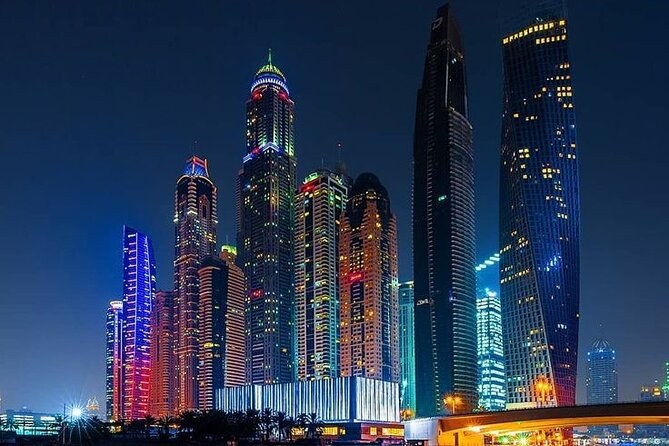
The Best Time of Day and Year for a Dubai Layover Tour
If you can choose which connection to book, this guide tells you which one to choose. Two published schedules decide almost all of it, and neither is a matter of opinion.
The two schedules that decide it
First, the heat. Dubai's published normals put July at 40.6°C and August at 40.4°C, with overnight lows near 29°C. January sits at 24.0°C. That is not a gradient, it is two different cities.
Second, The Dubai Fountain, which performs at 13:00 and 13:30 Saturday to Thursday, 14:00 and 14:30 on Friday, then every thirty minutes from 18:00 to 23:00. Free, five minutes long, and beside the Burj Khalifa.
Between them those two facts answer most of the question.
What is the best time of day?
Between 18:00 and 23:00, in every month of the year. The fountain is running, the towers are lit, the temperature is bearable even in July, and the souks are at their busiest. An evening connection is worth more than a daytime one for the same money.
The one exception is the old quarter. Al Fahidi and the souks reward a morning visit in the cooler months, because the light is better and the lanes are empty.
What is the worst time of day?
16:00 to 19:00 on a weekday, when Sheikh Zayed Road slows to a crawl. A route that has to cross the city in that window loses half an hour to nothing at all.
A good guide plans around it by running the circuit outward-in. If your connection falls exactly there, ask for old Dubai rather than the coast.
Which months are best?
November first, then December, January and February. Highs between 24 and 30°C, and the walking stops comfortable at any hour. November edges it because December brings the visitor peak and February brings the rain.
| Month | Mean high | Rain | Best connection |
|---|---|---|---|
| January | 24.0°C | 11.3mm | Any |
| February | 24.6°C | 35.7mm | Any, with slack |
| March | 27.9°C | 22.4mm | Any |
| April | 32.4°C | 7.6mm | Morning or evening |
| May | 36.8°C | 0.7mm | Evening |
| June | 38.8°C | 0.0mm | Evening |
| July | 40.6°C | 0.0mm | Evening only |
| August | 40.4°C | 0.0mm | Evening only |
| September | 38.7°C | 0.0mm | Evening |
| October | 35.1°C | 0.0mm | Late afternoon |
| November | 30.5°C | 1.8mm | Any — the best month |
| December | 26.2°C | 14.3mm | Any |
Figures from the WMO climate normals for Dubai.
Is a summer layover worth doing at all?
Yes, on an evening connection. Between June and September the daytime is genuinely hard work — one operator warns of peaks between 42 and 45°C with humidity above 90 per cent — but after dark the city is comfortable, well lit and much quieter than in winter.
A July evening tour is a better experience than an April afternoon one. It is also cheaper to book, because summer is low season.
What changes during Ramadan?
Attraction hours shift — the Dubai Frame states that its own timings vary during Ramadan and public holidays — and eating and drinking in public during daylight is not done. Evening comes into its own, because the city is at its busiest and best-lit after sunset.
Tours run throughout. Check the timings of anything you plan to go inside, and expect the roads to be busier after dark than before it.
Does rain ever stop a Dubai layover tour?
Rarely. February is the wettest month at 35.7mm across about four days, and rain here falls in short heavy bursts rather than all day. It can flood a road for an hour, which is a timing problem rather than a cancellation.
Every tour listed refunds in full at 24 hours if you would rather not take the chance.
Morning, afternoon or evening?
- Morning (07:00–11:00). Best for the souks and Al Fahidi, in the cooler months. Quiet, good light, no fountain.
- Afternoon (11:00–16:00). The weakest slot in any month. Hot in summer, and the fountain has only its two short shows.
- Evening (18:00–23:00). The best in every month. Fountain, lit towers, bearable heat, souks open.
Which tours run at the right times?
Several here are built specifically for the evening, and one operator's own hours run from 15:00 to 21:00. Others run around the clock, which matters for the pre-dawn arrival bank — a four in the morning landing needs an operator that is awake.
The night-tour page covers the evening products in full.
Planning around your own flight
You usually cannot choose your connection, and that is fine: every month of the year works with the right adjustments. What you can choose is which tour, and how long. In summer, book the evening slot and keep the walking short; in winter, take the daytime one and add Al Fahidi.
The month-by-month page has the detail, and Dubai Layover Tour lists which departures run when.
What the heat actually changes about a day out
Not the itinerary — the stops are the same in January and July. What changes is how long you spend outside the car at each one. In winter a guide will park and walk you through Al Fahidi for forty minutes. In August the same stop becomes fifteen minutes and a photograph, because standing in 40°C with humidity above 90 per cent is not sightseeing.
That is the honest summer trade, and it is why the evening slot is not a consolation. At nine at night in August the temperature is in the low thirties, the souks are open, the fountain is running and the pavement is bearable. You get the same city with the difficulty removed.
Humidity, and why the thermometer understates it
Dubai's summer problem is not only the air temperature. Humidity above 90 per cent means sweat does not evaporate, so 40°C on the coast feels considerably worse than 40°C inland, and the difference between standing in shade and standing in sun is larger than the number suggests. It is why the operators' own summer advisories talk about humidity as well as heat.
The practical effects are small and easy to plan for. Carry water, which most of these tours provide. Keep the walking stops to fifteen or twenty minutes. And treat the air-conditioned car as part of the itinerary rather than as transport between the real parts of it — in July it genuinely is.
Which months fill up, and what that costs you
December to February is peak season in Dubai, and it shows in two places. Timed tickets — the Burj Khalifa observation deck above all — sell out further ahead, so book the slot before you fly rather than asking your guide on the day. And the fountain promenade is crowded enough at weekends that finding a spot takes ten minutes of your fifteen.
Summer is the opposite: quieter, cheaper and easier to book late. If you are flexible about which connection to take, a July evening is a better experience than a December afternoon, and it costs less.
Does the season change which tour to book?
It changes the length as much as the timing. In winter a six-hour booking gets you both halves of the city at a walking pace, because you can be outside comfortably at any hour. In July the same six hours produce less, because every stop is shorter, so the better use of a summer connection is a shorter booking taken in the evening rather than a long one taken in the afternoon.
It also changes which products suit. The night-specific listings come into their own between June and September and are arguably wasted in January, when the daytime is the better half of the day. Between November and March, book whatever fits your flight; from May to September, book for the evening or do not book at all.
Sunrise, sunset and the light
Dubai's most photographed hour is the twenty minutes after sunset, when the sky is still blue and the towers are lit. In December that falls around 17:40 and in June around 19:15, which is a useful thing to know when you are choosing a start time.
Early morning has its own case, and it is under-used. Between 07:00 and 09:00 the souks are opening, the light is low and clean, and the roads are moving. If your connection lands at dawn and you have six hours, the morning version of this trip is the quietest you will ever see the city.
The short version
November is the best month, evening is the best time, and 16:00 to 19:00 on a weekday is the one window to avoid. In July and August, evening is not a preference, it is the answer. And in any month, being in Downtown after six gets you the fountain for nothing.
Frequently asked questions
What is the best month for a Dubai layover?
November. Highs of 30.5°C, almost no rain, and the walking stops comfortable at any hour, before the December visitor peak arrives.
Is a Dubai layover tour worth it in summer?
On an evening connection, yes. Daytime highs of 40°C-plus make the walking stops hard work, but the city after dark is comfortable and much quieter.
What time does the Dubai Fountain run?
At 13:00 and 13:30 Saturday to Thursday, 14:00 and 14:30 on Friday, then every thirty minutes from 18:00 to 23:00. It is free to watch.
Do tours run during Ramadan?
Yes, on adjusted hours. Attraction timings shift and eating in public during daylight is not done; evening tours are the better choice.
What is the worst time of day to be on the road?
16:00 to 19:00 on a weekday, when Sheikh Zayed Road slows badly. Ask for old Dubai rather than the coast if your connection falls there.
Does it rain enough to matter?
Only in February, at 35.7mm across about four days, and it comes in short heavy bursts. Plan a little slack rather than avoiding the month.
Tours built for the evening
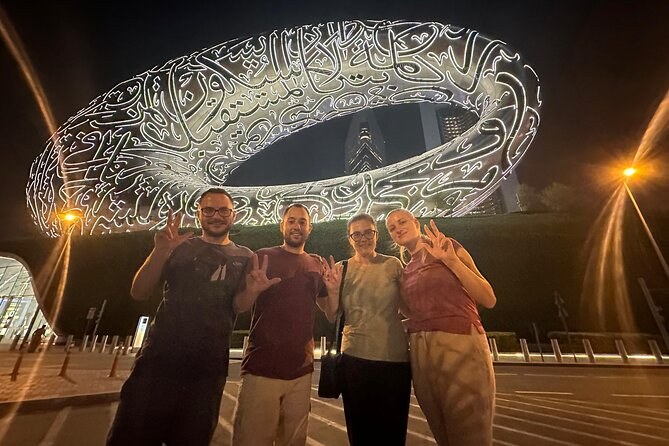
Dubai Night Stopover Layover & Transit Tour + Airport Transfers
Private2 to 10 hours
From $85 per person